f3ccc2 No.621159
>tfw knowing koine greek and can actually read the new testament in its original form
What Christian language do you know?
725857 No.621161
I've wanted to learn Latin for the longest time, but never got beyond Latin prayers
acd789 No.621167
>>621159
I know Latin so I can into Vulgate. Ha. I can’t read Greek without the interlinear though. I hope to fix that one day.
24480d No.621169
>>621159
I'm thinking about learning Koine Greek to understand the Septuagint and the NT, in addition to the ante-Nicene Fathers. Then Latin, or the other way around.
Did you just use books to learn it?
eb30ea No.621174
>>621159
Wanting to learn Koine Greek and maybe Church Slavonic though I know it won't be very useful but regardless I wouldn't know the first step on learning either anyhow. Any insight, anons? How'd you go about it, OP?
f3ccc2 No.621177
YouTube embed. Click thumbnail to play.
>>621169
I watched Steven Anderson's introductory videos, and went on from there, using various online resources to learn the grammar. I have all the grammar memorized, and a fair bit of vocab as well so I can read smoothly. I'm by no means perfect but I can stand on my own feet well.
f3ccc2 No.621178
e052af No.621180
20fc01 No.621181
>>621159
I know koine, learned in college
This textbook was seriously helpful. Devour it and you. will know koine.
http://icotb.org/resources/GreekGrammar-Machen.pdf
f3ccc2 No.621185
YouTube embed. Click thumbnail to play.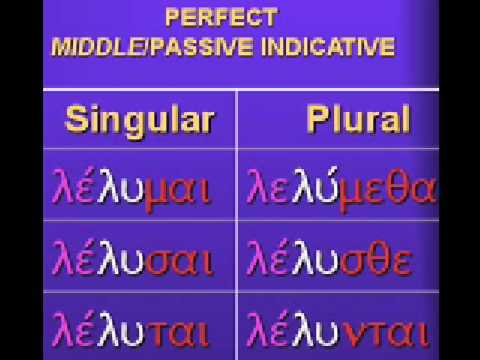
>>621169
>>621174
Picture is noun case endings using the definite article; video is for verbs in the indicative mood.
Koine Greek Alphabet (Lowercase):
α = a
β = b
γ = g
δ = d
ε = e
ζ = z
η = e/i
θ = th
ι = i
κ = k
λ = l
μ = m
ν = n
ξ = x
ο = o
π = p
ρ = r
σ/ς = s
τ = t
υ = y/u
φ = ph/f
χ = ch
ψ = ps
ω = oo
Enjoy learning. Use Steven Anderson's intro videos for more info.
944c5b No.621191
English because the Word of God is written in it.
375d06 No.621196
Anyone interested in Aramaic? Or modern Syriac?
e2b7b5 No.621218
>tfw you converse with angels in enochian
ac1b6a No.621248
>>621159
I know some Hebrew, if that counts.
e2b7b5 No.621262
>>621159
>>621167
>>621181
is it worth it did you actually get greater understanding or did you get memed?
5e5192 No.621297
We should create an "ancient language general"; in order to practice and share resources/advices.
4323e4 No.621300
>in its original form
uhhh… you do realize it was written in english right?
af54e2 No.621355
>>621262
I just looked at the Latin Vulgate. It’s so scary and to the point it makes even the Douay Rheims and KJV look like fairytales.
a46567 No.621358
>>621191
Tis true. On the day of Pentecost James was gifted by the Holy Spirit to write everything in English even books that had yet to exist.
This writing become known as the king of above all other versions written in other langues
What he wrote came to known as the the KJV
3e25a3 No.621360
f3ccc2 No.621452
>>621262
Yes, it was worth it. It helps decide which translations are good and which are shit. Also helps argue against heretics as well by going back to the original Greek.
d0743d No.621458
>>621452
Care to list good and bad translations?
d0d956 No.621462
Is the Novum Testamentum Graece: Nestle-Aland really the best version of the Bible in Koine Greek or is there some other version that's better?
99a9ee No.621465
>>621297
/pisslam/ has an Arabic general, this would be a good place to pool resources. Maybe give it a sticky
99a9ee No.621467
>>621462
It’s about the best you can get, it has a ton of notes
14f320 No.621487
f3ccc2 No.621501
>>621458
The NKJV is really good, and if you want a super literal translation, then use YLT which doesn't even change verb tenses.
b9b5de No.621504
>>621159
>tfw reading the Bible with the force and power of the Holy Spirit
bfce2d No.621512
>>621465
That sounds like a good idea. We've needed one of these.
f3ccc2 No.621685
>>621452
>>621458
>>621501
Here's the most literal translation I could give of the Lord's prayer that makes sense:
>"Our Father in heaven, hallowed be the name of you,
>Your Kingdom come, your will be done, as in heaven so on earth.
>Our daily bread give us this day:
>And forgive us of our trespasses, as we have forgiven those who trespass us.
>And may you not lead us into temptation, but deliver us from hardship."
48d767 No.621691
>>621685
>deliver us from hardship.
I guess modern society deems hardship and evil to be the same thing.
f3ccc2 No.621701
>>621691
I guess so, but not every Greek word maps exactly onto a single word in English, there is semantic range so you have to interpret its meaning best you can. Here's the Greek I translated from Matthew 6:
Πάτερ ἡμῶν ὁ ἐν τοῖς οὐρανοῖς, ἁγιασθήτω τὸ ὄνομά σου,
ἐλθέτω ἡ βασιλεία σου, γενηθήτω τὸ θέλημά σου, ὡς ἐν οὐρανῷ καὶ ἐπὶ γῆς.
Τὸν ἄρτον ἡμῶν τὸν ἐπιούσιον δὸς ἡμῖν σήμερον:
καὶ ἄφες ἡμῖν τὰ ὀφειλήματα ἡμῶν, ὡς καὶ ἡμεῖς ἀφήκαμεν τοῖς ὀφειλέταις ἡμῶν:
καὶ μὴ εἰσενέγκῃς ἡμᾶς εἰς πειρασμόν, ἀλλὰ ῥῦσαι ἡμᾶς ἀπὸ τοῦ πονηροῦ.
f3ccc2 No.621702
>>621701
>ἐν τοῖς οὐρανοῖς
I should have translated that as "in the heavens." Oh well.
48d767 No.621707
I'm going to try and translate the Vulgate as literally as possible.
Genesis 1
In the beginning God created space and land.
The land was vacant and empty and darkness was on the face of the abyss and the spirit of God moved on the water
And God let there be light and there was light.
And God saw the light was good and divided the light from the darkness.
God called the light day and the darkness night and together they made one day.
And God said let there be firmament in the middle and let it divide waters from waters.
And God created the firmament dividing the waters above from the waters below and it was so.
f3ccc2 No.621709
>>621707
Noice. I should learn Latin when I have the time.
248ec7 No.621711
>>621159
I hear Steve Anderson knows Koine Greek, too.
f3ccc2 No.621713
>>621711
Yes, his introduction videos are actually not to bad, they did give me a general sense of the overall language. He does go all
>MUH KJV
a few times during the lessons, but whatever, the videos are still helpful.
35b9d4 No.621721
>>621685
Temptation is better translated as trial or trialling. Debt is also probably more accurate than trespass.
Within the Greek and Syriac versions "evil" at the end seems to be in the determinate state rather than an abstract noun.
https://hermeneutics.stackexchange.com/questions/13326/deliver-us-from-evil-or-the-evil-one-help-from-the-semitists
https://hermeneutics.stackexchange.com/questions/13343/did-matthew-intend-evil-or-the-evil-one-in-the-lord-s-prayer
It should also be taken into account that the ancient languages like Aramaic, Greek, and Latin the word translated as evil is used as a general term for badness whereas "evil" today connotes a greater amount of malevolence although in earlier periods evil was used in a similar form as a general term for badness with cognates across all Germanic languages with the word "bad" possibly being a late loan from Old Norse.
248ec7 No.621726
>>621292
>John Dee
wew lad! VERY obscure joke/comment
I'll allow it.
>>621191
Not so obscure, pretty obvious and inyourface /christian/ humour, really, but still, I'll pay that.
f3ccc2 No.621730
>>621721
As said, by no means am I perfect at this, but thank you for the information. I mostly learn my vocab from Greek lexicons which don't always give the best definitions.
8eedf9 No.621735
>>621159
>tfw when not a smug asshole about my knowledge
f3ccc2 No.621744
>>621735
I'm literally trying to spread knowledge anon. Please take advantage of the resources I've provided and learn. :)
6834fd No.621750
>>621297
Not a bad idea. If someone comes up with a good OP, it should be a sticky.
f3ccc2 No.621751
>>621721
Here, I modified my translation:
>Our Father in the heavens, hallowed be the name of yours,
>Your Kingdom come, your will be done, as in heaven so on earth.
>Our daily bread give us this day:
>And forgive us of our debts, as we have forgiven those who are debters against us:
>And may you not lead us into trial, but deliver us from hardship.
de3d83 No.621782
>>621462
1904/12 Patriarchal Text master race reporting in
35b9d4 No.621789
>>621751
The possessives are better off translated as they are usually before the noun than trying make it resemble the Greek more closely by placing it after the noun and introducing the "of" preposition which itself is alien to the text.
Similar could be said of the "of our debts" and "those who are debtors against us".
>Our Father in the heavens, hallowed be your name.
>Your Kingdom come, your will be done, as in heaven also on earth.
>Our daily bread give us today.
>And forgive us our debts, as also we forgive our debtors.
>And bring us not into trial, but deliver us from the evil one.
f3ccc2 No.621807
>>621789
Thank you friend, I think I am doing well overall, but there is still some room for improvement.
5e5192 No.621889
I know it might be best to know both, but should I start with Latin or Koine Greek? I lean more towards Latin since my main language is French.
d0743d No.621893
>>621889
The Latin Vulgate is a translation of the original Greek, so it's less "pure" than Greek.
0a1cdb No.621894
>What Christian language do you know?
Polish
5e5192 No.621897
>>621893
Ok, but I'll be able to read the Catholics theologians in the original language, that's why I want to know both ultimately
7c8315 No.621922
>What Christian language do you know?
Serbian
d0743d No.621926
d0743d No.621943
>>621707
I'm Vulgating again, this time with the beginning of Genesis 2
Genesis 2
Therefore, perfected are the space and land and all their hosts.
God rested on the seventh day from all the work he had made.
Thankful and holy is the seventh day for on that day God rested from all the work he had done and all he created.
This is the account of the creation of space and land and the day God made them.
And every young plant of the land was in the fields and before it all rose the grass rose up, for the Master God did not send rain on the ground and there was not man to cultivate it.
And the source of water went up and watered all the surfaces of the land.
And Master God formed man from the slime repository of the earth and breathed life into his nostrils and man became a living creature with a soul.
f8a500 No.621948
>>621159
I hope to learn Greek better this year.
>>621685
>>621701
Are you a catholic by chance? Don't want to make a big deal of it, but your text and translation doesn't include the doxology, which is not in the western text:
>"οτι σου εστιν η βασιλεια και η δυναμις και η δοξα εις τους αιωνας αμην"
<"for Yours is the kingdom and the power and the glory to the ages. Amen." -(LITV)
d0743d No.621966
>>621943
Master God planted a pleasure paradise where he put man which he had created.
Out of the soil God grew all trees that were fair in appearance and the tree of life in the garden which was the tree of the science of good and evil.
And the water went out of the place of pleasure to water the garden and it divided into four heads
The name of the one Phiso is the name of the one that circles around the whole land of Evilat where there is gold.
And the gold of the land is good and it will be found with Lapiz Lazuli.
And the second river is Geon and it circles around all of Ethiopia.
And the third river is the Tigris which goes to the east towards Assyria. However, the fourth river is Euphrates.
00465b No.621974
>>621948
>Are you a catholic by chance? Don't want to make a big deal of it, but your text and translation doesn't include the doxology, which is not in the western text:
This doxology is from Didache
The holy Fathers prior to S. Chrysostom, as Grotius observes, who have explained the Lord's prayer, never mention these words. — And not being found in Tertullian, S. Cyprian, S. Jerom, S. Ambrose, S. Augustine, &c.
24480d No.621976
>>621974
Didache for near-Canon tbh. I really like it as sort of a summary of Christian ethics and behavior, and I love how they just call out abortion (modern Christians think we face something new, when we don't).
f8a500 No.621990
>>621974
I was just curious what denom he was, given he didn't post the longer variant.
I know the argument, and with 97% of MSS containing the doxology(according to Pickering), I would rather retain it as original.
f3ccc2 No.621995
>>621948
I am Protestant Anglo-Catholic, I omitted the doxology because it does not appear in western manuscripts and is omitted from the Vulgate.
f8a500 No.622009
>>621995
Ok makes sense, keep up the good work anyway.
f3ccc2 No.622037
>>621707
>>621943
>>621966
Here's Genesis 1:1-7 from the Septuagint.
>In the beginning God made heaven and earth.
>The earth was invisible and nothing, and darkness was above the abyss, and the Spirit of God was above the water.
>And God said, "Light be!"; and light was.
>And God saw the light was good; and God separated the midst of the light against the midst of the darkness.
>And God called the light day and the darkness he called night; and it was evening and morning - day one.
>And God said, "Firmament be in the midst of the water and be separated against the midst of the water."; and so it was.
>And God made the firmament, and God separated the water in the midst against it, which was below the firmament, and against the midst of the water above the firmament.
00465b No.622042
>>621976
I am not saying that it's wrong (we use it in Mass after all). Just a correction of common mistake.
And as for abortion - Paul and John calls it out too, but it's somewhat less direct way. In Gal 5:20, Rev 9:2, Rev 9:21 and Rev 21:8 etc. "sorcery" is condemned but greek word is actually pharmakeia which include not only drug usage but also pharmaceutic abortion.
>>621990
Considering that early Christians did not use it I beg to differ.
f8a500 No.622070
>>622042
>Considering that early Christians did not use it I beg to differ.
Ok
8f4b80 No.622132
Greek looks to hard man… I don't have time to learn this… I wish I did though…
8b8c47 No.622146
https://m.youtube.com/watch?v=aK10AOoLflc
In Aramaic the word for debt and sin was the same.
f8a500 No.622151
>>622146
Thanks for the link
82525a No.622154
I just need to know English for my KJV
701289 No.622155
>>622146
>In Aramaic the word for debt and sin was the same.
Strange, in the Greek (and I believe the original Hebrew) the word used for sin meant "missing the mark."
701289 No.622157
>>622155
This is interesting because it means the original sin of choosing knowledge of good and evil meant deciding morality for yourself and choosing incorrectly, resulting in a life destined to be full of sin (which all atheists and many mainstream Christians have done.)
>>621966
>the tree of the science of good and evil
Original sin is putting our concept of right and wrong before God's, including choosing false idols like equality or money.
35b9d4 No.622196
>>622146
>>622155
They may be equated in interpretation but they seem to be distinct terms.
In Greek there's opheilé (ὀφειλή) for debt which is translated with ܚܘܒܐ (ħwb') in Syriac. In both languages it refers to something owed and related words have a sense of ought.
http://dukhrana.com/lexicon/lexeme.php?adr=1:973&font=Estrangelo+Edessa&size=125%25
Sin on the other hand is what has been used to translate ἁμαρτάνω (hamartánō) and related terms which have a sense of offense, failure, wrongdoing, mistake etc. In the Peshitta it is translated with ܣܟܠ (skl) and ܚܛܐ (ħt').
http://dukhrana.com/lexicon/lexeme.php?adr=1:2129&font=Estrangelo+Edessa&size=125%25
http://dukhrana.com/lexicon/lexeme.php?adr=1:1010&font=Estrangelo+Edessa&size=125%25
The association is attributable to the use of sin in place of debt in the Lord's prayer in Luke.
c0751c No.622229
I really want to learn Latin but don't know where to start and how to practice speaking it
f3ccc2 No.622237
>>622229
I'm sure there are a lot of online resources and places where you can buy a book to help study. You should learn grammar of a language before you memorize a bunch of random vocab. See how nouns and adjectives work as well as verb conjugations and etc. After that, then start focusing on vocabulary. Happy learning friend.
35b9d4 No.622247
>>622237
>You should learn grammar of a language before you memorize a bunch of random vocab.
I've heard the reverse having been said about learning any language.
0bb559 No.622255
>>622247
With Latin you should learn the grammar and conjugation first. It has no individual words for "I" or "you", for example, so it's extremely dependent on the use of the correct conjugation.
Also the Latin used by the Catholic church is different from that used by the Romans, although not to an extreme degree.